
The main reason for using geomembrane sheets in insulating a range against water penetration into the soil.
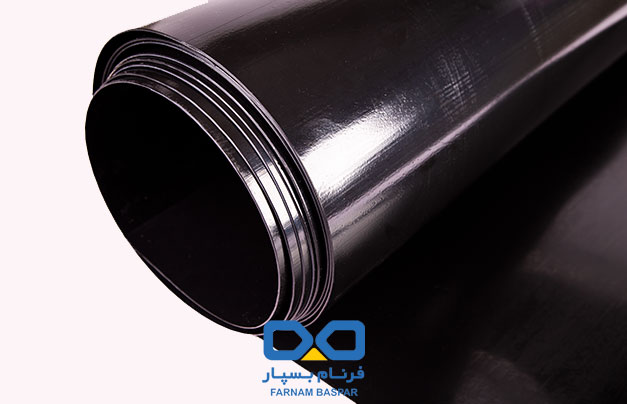
Our geomembrane sheets, with precise technical specifications and a variety of types, provide a reliable solution for environmental engineering and construction applications. Each product undergoes strict quality control and complies with international standards to ensure exceptional performance and durability. Additionally, with competitive pricing, they represent an economical and valuable choice for various projects.
Standards and Certifications are vital in ensuring the quality, safety, and performance of Farnam Baspar’s geomembrane sheets. As a leading manufacturer in Iran, we adhere to international and national standards to deliver products that meet the highest industry benchmarks. Our commitment to excellence is reflected in our rigorous testing and compliance processes.
Key Standards and Certifications
| HDPE (High-Density Polyethylene) | |
|---|---|
| Density (g/cm³) | 0.940 |
| Available Thickness (mm) | 1-3 |
| Available Widths (m) | 3, 6, 7, 8 |
| Roll Length (m) | 50-150 |
| Available Colors | Black |
| Textured geomembrane | |
|---|---|
| Density (g/cm³) | 0.940 |
| Available Thickness (mm) | 1-3 |
| Available Widths (m) | 3, 6, 7, 8 |
| Roll Length (m) | 50-150 |
| Available Colors | Black |
| LLDPE (Linear Low-Density Polyethylene) | |
|---|---|
| Density (g/cm³) | 0.939 |
| Available Thickness (mm) | 1-3 |
| Available Widths (m) | 3 |
| Roll Length (m) | 50-150 |
| Available Colors | Black |
| Blue-Black Geomembrane | |
|---|---|
| Density (g/cm³) | 0.940 |
| Available Thickness (mm) | 1 |
| Available Widths (m) | 3 |
| Roll Length (m) | 50 |
| Available Colors | Blue-Black |
| PVC (Polyvinyl Chloride) | |
|---|---|
| Density (g/cm³) | 1.35 |
| Available Thickness (mm) | 1.5, 2 |
| Available Widths (m) | 1.6 |
| Roll Length (m) | 15 |
| Available Colors | White & Black |
Farnam Baspar offers a diverse range of geomembrane products, each engineered for specific applications and environmental conditions. The primary types of geomembranes manufactured by the company include:
Each product line is manufactured in compliance with international standards such as GRI-GM13, ASTM, ensuring durability, impermeability, and resistance to chemical and environmental degradation.
Farnam Baspar ensures the highest quality in its geomembrane sheet production through rigorous quality control procedures and strict adherence to both international and national standards. The company maintains a certified quality management system and conducts continuous monitoring at every stage of production.
Quality Control Measures:
Certifications and Standards:
Farnam Baspar’s geomembrane sheets are manufactured in accordance with major international standards:
The company also holds the following quality management certifications:
These standards ensure that Farnam Baspar’s products meet the most stringent criteria for durability, impermeability, environmental safety, and performance in critical applications such as landfills, mining, aquaculture, and hydraulic infrastructure.
Advantages of Using Geomembranes in Aquaculture and Fish Farming:
Improved Productivity and Water Quality
Reduced Construction and Maintenance Costs
Enhanced Durability and System Stability
Applications of Geomembrane Sheets in the Oil and Gas Industry:
Advantages of Using Geomembrane Sheets in Oil and Gas Projects
Advantages of Using Geomembranes in Agriculture
The use of geomembranes in agriculture boosts productivity, conserves resources, and reduces operational costs:
Optimized Water Resource Management
Soil and Environmental Protection
Cost Reduction and Enhanced Durability
Advantages of Using Geomembranes in Environmental Projects
Geomembranes offer significant benefits for landfill and waste containment systems:
Advantages of Using Geomembranes in Mining
Integrating geomembranes into mining operations enhances environmental safety, reduces costs, and improves project efficiency:
Advantages of Using Geomembranes in Transportation Projects
Advantages of Using Geomembranes in Urban Projects
Advantages of Using Geomembranes in Hydraulic Structures
Advantages of Using Geomembranes in Energy Applications
Farnam Baspar’s geomembrane sheets are used by a wide range of customers across various sectors that require high-performance impermeable liners. These customers operate in industries where environmental protection, fluid containment, and structural durability are critical.
Key Customer Sectors:
These customers value Farnam Baspar’s products for their durability, chemical resistance, UV stability, and compliance with international standards (e.g., GRI-GM13, ASTM, and DIN EN). The company also supports custom manufacturing to meet specific project requirements.
The prices of most manufactured products, including geomembranes, fluctuate on a daily or weekly basis due to various influencing factors. For precise and up-to-date pricing information on 6, 7, and 8-meter geomembrane sheets in Iran, you can directly contact Farnam Baspar, a leading geomembrane manufacturer in the country. We are committed to providing accurate and transparent pricing tailored to your project needs.
Farnam Baspar stands out as one of Iran’s leading manufacturers of geomembrane and geosynthetic products, offering a combination of technological expertise, international certification, and customer-focused service.
Farnam Baspar is the the only brand in that produces these sheets in 6,7 and 8 meters for easier installation and less sewing line on the surface of the pool or tank. We offer the best products with the best quality and we are present as a reliable brand in the world markets. You can contact us to know 6, 7 and 8 meter geomembrane price in Iran.
Here are the key reasons to choose Farnam Baspar:
By combining engineering excellence, certified quality, and practical field experience, Farnam Baspar ensures cost-effective, reliable, and durable solutions tailored to the challenges of today’s infrastructure and environmental projects.
How do I choose the right geomembrane for my project?
Selecting the appropriate geomembrane for a project depends primarily on the technical and environmental conditions of the application. The first step is to clearly define the intended use of the structure—whether the geomembrane is required for water or wastewater storage ponds, landfill liners and covers, canal linings, or mine tailings facilities.
Once the application is established, several key factors should be considered:
Temperature fluctuations, UV exposure, and the nature of the contained fluid (water, chemicals, industrial effluent) all play a critical role in material selection.
Depending on the anticipated stresses and design life, thicknesses typically range from 1.0 mm to 3.0 mm. Increased thickness provides higher resistance against puncture and mechanical damage.
The chosen product must comply with relevant international standards (such as GRI, ASTM, and ISO) or applicable national specifications.
Ultimately, the final selection should be based on geotechnical investigations, subgrade evaluations, and consultation with geosynthetics specialists to ensure both technical performance and cost-effectiveness.
What is the lead time for ordering geomembranes?
The lead time for supplying geomembranes depends on several key factors:
If the required geomembrane (in terms of polymer type and thickness) is available in stock, delivery can be arranged within just a few business days.
For projects that require specific thicknesses, special widths, or uncommon polymer formulations, the geomembrane must be custom-produced. In such cases, the lead time typically ranges from 2 to 3 weeks.
Large-scale orders may require extended production scheduling and additional logistical coordination.
For international projects, shipping (by sea or land) and customs procedures can add to the overall delivery time.
In general, it is strongly recommended that owners and contractors place geomembrane orders several weeks prior to the scheduled installation date to avoid potential delays.
Do you offer a warranty on geomembranes?
Yes, our geomembranes are supplied with a comprehensive warranty covering both product quality and installation. Unlike standard warranties that only address manufacturing defects, we also extend coverage to the installation process when it is carried out by our certified teams.
Ensures the quality of raw materials, uniform thickness, and compliance with international standards such as ASTM, GRI, and ISO.
When installation is performed by our in-house or certified crews, any issues arising from improper welding or installation errors are also fully covered under warranty.
Depending on the type of product and project conditions, the warranty period typically ranges from 5 to 10 years.
By offering installation coverage in addition to product warranty, our company demonstrates a complete commitment to quality and long-term performance, providing clients with maximum confidence throughout the service life of their projects
Are your geomembranes resistant to chemicals?
Yes, our geomembranes offer excellent chemical resistance, which makes them an ideal choice for environmental and industrial containment applications.
The polymeric structure of these products ensures that they maintain their mechanical and hydraulic properties even under long-term exposure to aggressive fluids.
Although geomembranes resist most chemicals, certain aromatic hydrocarbons, heavy oils, and strong organic solvents may require specific Chemical Compatibility Testing to confirm suitability.
Chemical resistance is verified according to internationally recognized testing procedures, including ASTM D5322 and EPA 9090.
In summary, our HDPE, LLDPE, and PVC geomembranes are engineered to deliver reliable and long-lasting containment performance in chemically aggressive environments.
How long do Farnam Baspar’s geomembranes last?
Farnam Baspar’s geomembranes are manufactured using premium raw materials and optimized formulations, ensuring a very long service life.
Our HDPE and LLDPE geomembranes, when properly installed and maintained, can deliver safe and reliable performance for over 50 years.
These products are engineered to withstand UV exposure, temperature fluctuations, and moisture variations, while retaining their mechanical integrity and impermeability over the long term.
For projects involving direct contact with aggressive chemicals, chemical compatibility assessments are recommended to provide additional assurance of durability and service life.
Farnam Baspar geomembranes are manufactured in compliance with international standards such as ASTM and GRI, ensuring long-term durability and consistent performance in civil and environmental engineering applications.
In summary, Farnam Baspar’s geomembranes are designed and produced for long-lasting and reliable service, making them one of the most technically and economically efficient solutions for demanding projects.
Is special equipment required for installation geomembranes?
Yes, the installation of geomembranes requires specialized equipment and well-trained crews to ensure watertight performance and long-term durability of the system.
The most essential tools for geomembrane installation are wedge welders and extrusion welders, which are used to join panels and create strong, impermeable seams in accordance with international standards.
Prior to installation, the subgrade must be leveled and cleared of stones, roots, and sharp objects. This process requires the use of earthmoving machinery and compaction equipment.
To verify seam quality, tests such as air pressure testing, vacuum box testing, and spark testing are conducted during installation.
Depending on site conditions, the use of personal protective equipment—such as safety boots, heat-resistant gloves, and fall protection systems on slopes—is mandatory.
Farnam Baspar provides dedicated and highly experienced installation crews equipped with advanced machinery and trained to follow international standards. This ensures that geomembrane installation is executed with the highest quality and efficiency.
In summary, successful geomembrane installation requires specialized equipment and professional crews—and Farnam Baspar delivers both as a complete service to its clients.
What is your return policy for geomembrane products?
Farnam Baspar is committed to delivering geomembrane products of the highest quality, manufactured in compliance with international standards. Nevertheless, to ensure customer confidence, our return policy is defined as follows:
If a product is found to have a manufacturing defect, non-conforming thickness, or damage incurred during transportation, customers may return the goods. After technical inspection, the product will either be replaced or refunded.
Customized orders (e.g., products manufactured with special thicknesses or widths) are non-returnable due to their tailored nature, unless a proven manufacturing defect exists.
In cases of verified manufacturing defects, Farnam Baspar will cover all transportation and replacement costs. For other return requests, logistics expenses will be borne by the customer.
By implementing this policy, Farnam Baspar seeks to guarantee product quality while also ensuring long-term customer trust and satisfaction.
How is geomembrane shipped, and what are the delivery options?
Due to their large dimensions and sensitivity to mechanical damage, geomembranes require specialized packaging and handling. Farnam Baspar manages the shipping and delivery process in accordance with international standards.
Geomembrane rolls are supplied as tightly wound coils, covered with protective wrapping (plastic sheeting and, in some cases, palletized) to safeguard against moisture, dust, and potential damage during transport.
With extensive experience in both domestic and international projects, Farnam Baspar’s logistics team ensures the fastest, most reliable, and cost-effective shipping and delivery solutions for its clients.
| Geomembranes (width 3) | |
| thickness (mm) | 1,1.5,2,2.5 |
| length (m) | 50-100 |
| width (m) | 2.6-3 |
| density (g/cm3) | >0.94 |
| Packaging type | Roll |
| surface | Smooth- Textured |
| material | Poly Ethylene |
| color | Black |
| Warranty | 10 Years |
| waterproof | - |
| standard | GM-13, INSO 15582 |
| lifespan | Depend on application |
| application | agricultural water storage pool, pit sealing, oil and gas, factories industrial wastewater, enviromental protection |
| Coverage | |
| Geomembranes (width 7) | |
| thickness (mm) | 1,1.5,2,2.5 |
| length (m) | 50-150 |
| width (m) | 5.6-7 |
| density (g/cm3) | >0.94 |
| Packaging type | Roll |
| surface | Smooth |
| material | Poly Ethylene |
| color | Black |
| Warranty | 10 Years |
| waterproof | - |
| standard | GM-13, INSO 15582 |
| lifespan | Depend on application |
| application | agricultural water storage pool, pit sealing, oil and gas, factories industrial wastewater, enviromental protection |
| Coverage | |