
Geogrid sheets are among the most important geosynthetic engineering materials, featuring precise technical specifications and international standards. They play a vital role in soil stabilization and enhancing the strength of civil engineering structures. Farnam Baspar geogrid products, utilizing advanced technology and superior quality, offer optimal performance along with economic advantages and long service life for various projects. In this page, in addition to reviewing technical specifications, recognized standards, and unique benefits of this product, competitive prices are also provided to offer you a smart and cost-effective choice.
PP Datasheet
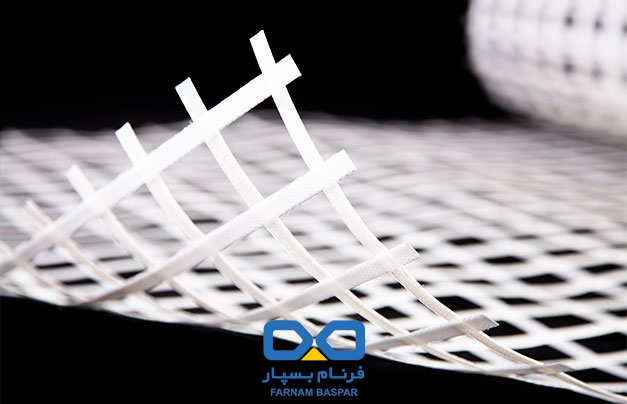
FB Grid60 is a geogrid made of stretched, monolithic, textured Polypropylene (PP) flat bars with welded junctions, used for reinforcement in various fields of civil engineering, including landfill engineering, including landfill engineering, road construction, and hydraulic engineering. The geogrid must not be coated with a separate polymer.
| Property | Test method | Values |
|---|---|---|
| Material | - | Polypropylene (PP) |
| Ultimate Tensile Strength | ASTM D6637 | 60 kN/m (MD) |
| 60 kN/m (CMD) | ||
| Minimum Rib Thickness (Nominal) | ASTM D5199 | 1 (mm) |
| Elongation at Ultimate Tensile Strength (Tolerance %10±) | ASTM D6637 | <10% |
| Aperture Dimensions (Nominal) | Measured | 5 (cm)*5(cm) |
| Roll Length | Measured | 75-100 (m) |
| Roll Width | Measured | 4 (m) |
PET Datasheet
FB Grid 60 is a high-performance biaxial geogrid manufactured by Farnam Baspar from high-tenacity polyester yarns, woven into a stable grid structure and coated with durable PVC. It provides a tensile strength of 60 kN/m in both machine direction (MD) and cross-machine direction (CMD), making it suitable for soil reinforcement, base stabilization, and other geotechnical applications.
| Property | Test method | Values |
|---|---|---|
| Tensile Strength @ 2%Strain | ASTM D6637 | 12 kN/m (MD) |
| 12 kN/m (CMD) | ||
| Tensile Strength @ 5%Strain | ASTM D6637 | 24 kN/m (MD) |
| 24 kN/m (CMD) | ||
| Ultimate Tensile Strength | ASTM D6637 | 60 kN/m (MD) |
| 60 kN/m (CMD) | ||
| Elongation at Ultimate Tensile Strength (Tolerance %10±) | ASTM D6637 | <12% |
| Aperture Dimensions (Nominal) | Measured | 2 (cm) * 2 (cm) |
| Minimum Rib Thickness (Nominal) | ASTM D5199 | 1 mm (MD) |
| 0.6 mm (CMD) | ||
| Resistance to UV Degradation | ASTM D4355 | 75% |
| Roll Length | Measured | 100 m |
| Roll Width | Measured | 5.20 m |
Farnam Baspar’s geogrid sheets, developed using advanced technologies and high-quality raw materials, are specifically designed to reinforce and stabilize soil in civil engineering projects. These products offer an efficient and cost-effective solution for enhancing the performance and extending the service life of soil structures. Below are some of the key features and advantages of these geogrid sheets:
1- High Tensile Strength:
These sheets possess high resistance against tensile forces, which enhances soil stability and strength.
2- Long Service Life and Durability:
Farnam Baspar geogrid sheets exhibit excellent resistance to corrosion, chemical agents, and harsh environmental conditions, ensuring long-term durability and reliable performance over time.
3- Easy and Quick Installation:
Due to their lightweight nature and suitable flexibility, Farnam Baspar geogrid sheets allow for fast, simple installation and handling, leading to reduced execution time and overall project costs.
4- Cost Efficiency:
The incorporation of geogrids enables a reduction in the quantity of required fill and granular materials, thereby optimizing material usage and resulting in considerable cost savings in geotechnical and infrastructure projects.
5- Reduction of Differential Settlements:
Through uniform load distribution, Farnam Baspar geogrids help reduce differential settlements, thereby improving the overall stability and reliability of the soil-structure system.
6-Environmental Compatibility:
Farnam Baspar geogrids are produced from environmentally stable and inert materials, ensuring minimal ecological impact and high compatibility with surrounding natural environments.
Farnam Baspar geogrid products are manufactured and tested in accordance with ASTM (American Society for Testing and Materials) standards to ensure reliable performance, structural integrity, and long-term durability in geotechnical applications. The key ASTM standards applied include, but are not limited to:
By adhering to these standards, Farnam Baspar ensures its geogrid products meet international quality benchmarks and perform effectively under demanding site conditions.
There are various types of geogrids available, such as biaxial geogrid, uniaxial geogrid, and triaxial geogrid. The cost of geogrid per square foot can vary depending on the specific application and requirements. You can contact Farnam Baspar to obtain the geogrid price in Iran.
Farnam Baspar geogrids have been extensively utilized by a diverse range of clients across both public and private sectors. Key customer segments include:
Farnam Baspar’s geogrid solutions have been successfully implemented in numerous national infrastructure projects, underscoring the company’s commitment to quality, reliability, and technical excellence.
Farnam Baspar stands out as a leading geogrid manufacturer in Iran by combining advanced production technology, strict quality control, and deep technical expertise. Key reasons for selecting Farnam Baspar include:
Farnam Baspar delivers trusted geosynthetic solutions designed to enhance the stability, efficiency, and longevity of soil-structure systems.
Frequently asked questions
How strong is geogrid?
The strength of a geogrid is typically measured in terms of its tensile strength, which is the maximum amount of tensile stress that the geogrid can withstand before breaking. The tensile strength of geogrids can vary depending on the specific product, material, and application.
How do I choose the right geogrid for my project?
Selecting the appropriate geogrid for a project depends on the type of application, geotechnical conditions, and design requirements. Several key factors should be considered:
Key parameters such as ultimate tensile strength, elongation at break, stiffness modulus, and creep resistance should be evaluated based on the anticipated loads and service life.
In chemically aggressive environments or where prolonged UV exposure is expected, geogrids with high chemical resistance and UV stability should be selected.
The gradation and angularity of the soil or aggregate are critical, as the geogrid must provide sufficient interlock with the fill to ensure effective reinforcement.
Final selection should comply with relevant international standards and guidelines (such as ASTM, EN, or BS) and be based on geotechnical investigations.
Ultimately, the selection of geogrids should be made in consultation with geotechnical engineers and geosynthetics specialists to ensure both technical efficiency and cost-effectiveness.
What is the lead time for ordering geogrids?
The lead time for supplying geogrids depends on several key factors:
If the required geogrid (in terms of uniaxial or biaxial type, tensile strength, and roll dimensions) is available in stock, delivery can usually be arranged within a few business days.
For projects requiring special specifications—such as higher tensile strength, wider roll dimensions, or specific polymer formulations—geogrids must be custom-produced. In such cases, the lead time typically ranges from 3 to 4 weeks.
Large-scale orders may require additional production scheduling and extended logistics coordination.
For international projects, shipping by sea or land, as well as customs clearance procedures, may add to the overall delivery time.
In general, it is strongly recommended that owners and contractors place geogrid orders several weeks prior to the scheduled installation date to avoid potential delays.
Do you offer a warranty on geogrids?
Yes, Farnam Baspar’s geogrids are supplied with a manufacturer’s quality warranty, reflecting our commitment to delivering durable products that meet international standards.
Geogrids are guaranteed for the quality of raw materials, declared tensile strength, dimensional consistency, and compliance with recognized standards such as ASTM, EN, and ISO.
Depending on the type of geogrid (uniaxial or biaxial), tensile strength, and project requirements, the warranty period typically ranges from 1 to 5 years.
The warranty covers retention of mechanical properties within the specified period, absence of manufacturing defects, and stability under normal environmental conditions.
However, installation, site preparation, and execution are the responsibility of the project contractor and are not included under the manufacturer’s warranty.
Farnam Baspar’s geogrids are engineered for soil reinforcement, slope stabilization, retaining wall construction, and subgrade improvement for roads and railways. Their long-term performance is assured when they are properly designed and installed by qualified contractors.
In summary, Farnam Baspar’s geogrid warranty is focused on product quality and compliance with technical specifications, while installation responsibility rests with specialized contractors.
Are your geogrids resistant to chemicals?
Yes, Farnam Baspar’s geogrids are designed with suitable chemical resistance for use in a wide range of geotechnical applications.
Polymeric geogrids (typically manufactured from polyethylene, polypropylene, or polyester with protective coatings) are stable against most soils, salts, and naturally occurring chemical compounds.
In particular, polyester geogrids with polymeric protective coatings exhibit high durability in alkaline soils and cementitious environments, such as those behind retaining walls or in soil structures reinforced with concrete.
Chemical resistance of geogrids is assessed according to international testing standards, such as ISO 13434 and ASTM D5819, to ensure long-term stability throughout the design life.
Overall, Farnam Baspar’s geogrids provide adequate chemical resistance under typical environmental conditions, ensuring reliable long-term soil reinforcement performance.
How long do Farnam Baspar’s geogrids last?
Farnam Baspar’s geogrids are manufactured from premium raw materials and designed in accordance with international standards, ensuring a very long design life.
Depending on the polymer type (polyester, polypropylene, or polyethylene) and environmental conditions, properly installed geogrids can perform reliably for more than 75 to 120 years.
Farnam Baspar geogrids are engineered to resist chemical degradation from soils, normal alkaline and acidic conditions, and ultraviolet (UV) exposure.
In applications such as embankment reinforcement, retaining walls, slope stabilization, and subgrade improvement for roads, geogrids are designed to maintain stable performance throughout the entire service life of the structure.
Geogrid service life is determined based on internationally recognized testing methods and design guidelines, ensuring long-term retention of mechanical properties.
In summary, Farnam Baspar’s geogrids are developed to deliver long-term, reliable performance in geotechnical and civil engineering projects.
Is special equipment required for installation geogrids?
No, the installation of geogrids generally does not require specialized or complex equipment. The process relies primarily on proper subgrade preparation and correct placement to ensure effective performance.
The underlying surface must be leveled and cleared of sharp objects, large stones, or any materials that could damage the geogrid.
Geogrids are typically unrolled manually or with light equipment. Cutting, when necessary, can be carried out using simple tools such as scissors or utility knives.
Geogrids are secured using steel pins, clamps, or by embedding the edges beneath fill materials to hold them in position.
After placement, soil or aggregates are spread over the geogrid and carefully compacted to achieve proper interlock between the fill particles and the geogrid structure.
Quality assurance focuses on ensuring correct overlaps, uniform tensioning of the geogrid, and adequate compaction of the fill material.
In summary, geogrid installation is a relatively straightforward process that does not demand advanced machinery, but it should be performed by experienced construction teams under engineering supervision to guarantee long-term stability and performance.
What is your return policy for geogrid?
Farnam Baspar manufactures and supplies geogrids in compliance with international standards and is fully committed to product quality. To ensure customer confidence, our return policy is defined as follows:
If a geogrid is found to have a manufacturing defect or does not meet the declared technical specifications, customers may return the product. Following technical inspection, the product will either be replaced or refunded.
Customized or special-order products (such as non-standard dimensions or tensile strengths) are non-returnable due to their tailored nature, unless a proven manufacturing defect exists.
In cases of verified manufacturing defects, Farnam Baspar covers all transportation and replacement costs. For other return requests, logistics expenses are the responsibility of the customer.
This policy is designed not only to ensure product quality and compliance with standards, but also to provide long-term customer trust and satisfaction.
How is geogrid shipped, and what are the delivery options?
Geogrids are lightweight, grid-structured materials that are typically shipped as compact rolls. Farnam Baspar manages the shipping and delivery of geogrids in accordance with technical requirements and international standards.
With extensive experience in both domestic and international projects, Farnam Baspar’s logistics team ensures the fastest, most reliable, and project-specific delivery solutions for its clients.
| thickness (mm) | 1 |
| length (m) | 75 |
| width (m) | 4 |
| density (g/cm3) | |
| Packaging type | Roll |
| material | Poly Propylene |
| waterproof | |
| color | Black or White |
| Warranty | |
| lifespan | 120 Years |
| application | foundation of structures, reinforced walls, road infrastructure |
| Coverage: |